The Quiet Work Shaping Tomorrow
From The Siegel Times, a special edition of our Year in Review, President and Executive Director Katy Knight examines the blueprints, partnerships, and strategies behind 2025’s most under-covered success stories.


From The Siegel Times, a special edition of our Year in Review, President and Executive Director Katy Knight examines the blueprints, partnerships, and strategies behind 2025’s most under-covered success stories.

Introducing The Siegel Times: our 2025 Year in Review, inspired by the look and feel of a classic news magazine and grounded in the work we’ve built together this year. More than a retrospective, this special report brings together feature stories from grantees, letters from leadership, and a clear record of what we’ve accomplished collectively—alongside playful, interactive moments designed to put the buzzwords of 2025 to rest and refocus on what actually matters. It’s a snapshot of a year defined not by hype, but by shared effort, learning, and progress.

At Siegel Family Endowment, we’ve spent the first half of 2025 contending with profound uncertainty—not as a problem to solve, but as a condition to navigate with intention, curiosity, and collective wisdom. A bit past the midway point in the year, Siegel President and Executive Director Katy Knight would like to share three questions that have shaped our thinking in the hope that they might resonate with your own.
As we reflect on the past year, it’s clear that artificial intelligence has dominated discussions across various domains. What surprises us, however, is not the volume of conversation but rather its lack of nuance. Having navigated many cycles of technological development, we recognize the urgent need to move beyond the simplistic “gloom vs. doom” narrative. Instead, we must critically examine what these technologies can do, what they cannot, and—most importantly—what we truly need from them.
Our latest grants reaffirm our commitment to building a more inclusive technological future by supporting comprehensive research, shaping human-centered policies, and fostering community-driven innovation to ensure these advancements benefit everyone.
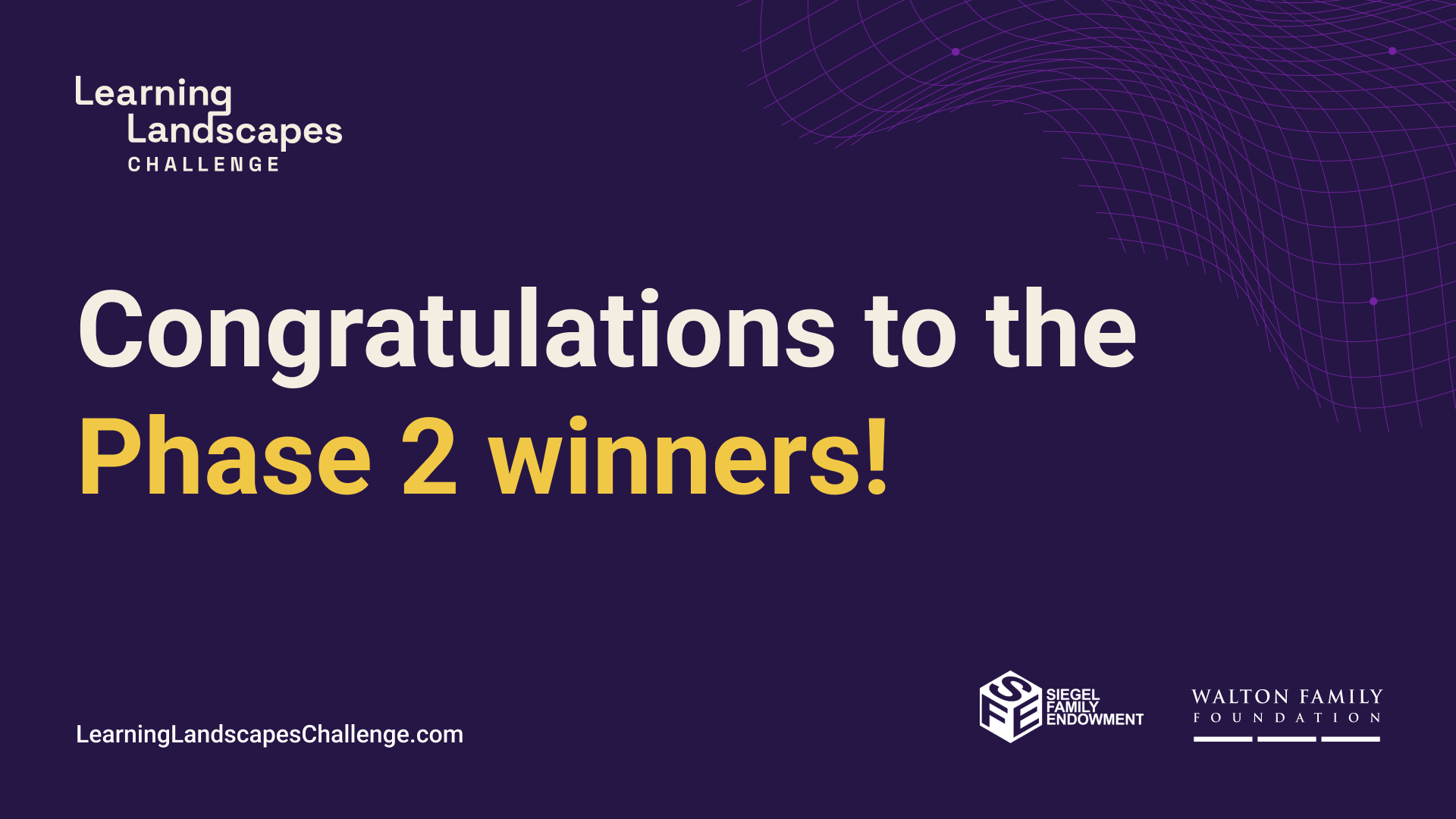
Siegel Family Endowment and the Walton Family Foundation are thrilled to announce five Phase 2 winners that will receive $200,000 each and advance to the Phase 3 incubator in the Learning Landscapes Challenge. These winners emerged from an exceptional cohort of 40 Phase 2 accelerator teams with transformative visions for K-12 educational infrastructure.

The U.S. National Science Foundation announced an inaugural investment of more than $18 million to 44 multidisciplinary, multi-sector teams across the U.S. through the NSF Responsible Design, Development and Deployment of Technologies (NSF ReDDDoT) program.

The White House Office of Science and Technology Policy convened leaders across the technology ecosystem to celebrate the important role of government technologists, and to highlight efforts to build a robust, inclusive technology landscape that works for everyone in America.

In a moment when research suggests that more than two-thirds of parents believe the benefits either equal or potentially outweigh the drawbacks and 72% of students want guidance on how to responsibly use generative AI for schoolwork, we should be wrestling with not whether but how technology can play a role in preparing young people for an increasingly dynamic world.

Siegel Family Endowment and the Walton Family Foundation are thrilled to announce the 40 Phase 1 winners of the Learning Landscapes Challenge. The winners will receive $5,000 each and an exclusive invitation to join the 14-week Phase 2 virtual accelerator.

At Siegel we believe that to build a future where technology serves the public interest and improves people’s lives, we need more than just technologists—we need people who come from many disciplines and backgrounds and can apply their unique skills and perspectives to solving big problems that span tech and society.