ICA has nurtured small businesses in the Bay Area through capital investment and mentoring for nearly thirty years. A central part of their approach is a form of impact investing that focuses on buying equity in promising companies rather than offering loans. As those businesses succeed, ICA creates pathways for the original owners to buy back that equity over time.
ICA Fund is known as an innovator in the CDFI field because it extends patient, flexible capital on founder-friendly terms to the small businesses in which it invests. This approach is in contrast to most CDFIs, which typically offer small businesses loans rather than convertible notes or equity investment options that have extended, flexible repayment expectations aligned with the businesses growth. It’s also in contrast to venture funding, which typically focuses on high-growth businesses and expects a high rate of return over a short period of time.
Building on our five-year partnership, we created this new series of case studies to spotlight ICA Fund’s work to shape a more inclusive economic system: one where entrepreneurs can access the capital and partnership they need to grow, where local economies thrive, and where quality jobs expand alongside profit. Each case study speaks to a core audience and a core belief: investors can generate both social impact and returns; business owners deserve capital designed for their success; policymakers can drive widespread economic growth by supporting equity investing that works for real people.
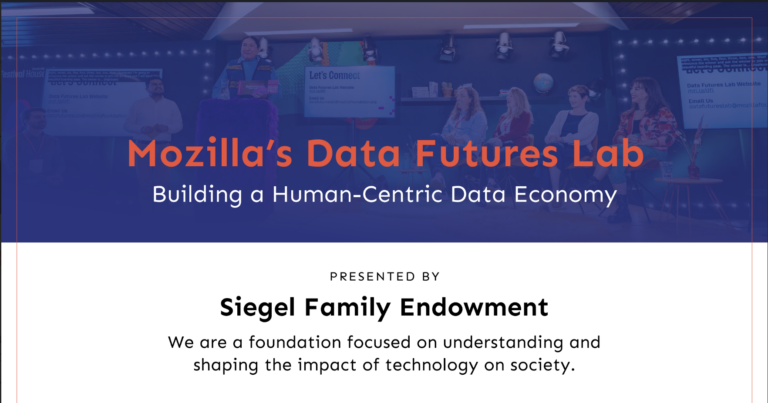
Data Futures Lab, a project of the Mozilla Foundation, served as an experimental space for developing new approaches to data stewardship. Its goal was to build tools and communities designed to offer such better ways—ways that give greater control and agency to people. In so doing, the project sought to advance policies, approaches, and tools that prioritize data co-creation, ownership, and stewardship in ways that benefit a diverse and inclusive public. Read more in our capstone case study.
#BlackTechFutures Research Institute is building a national and global network of city-based researchers and practitioners focused on bolstering sustainable local Black tech ecosystems.
The Feedback Incentives Learning Group is a group of funders and philanthropy support organizations dedicated to exploring ways to support nonprofits and motivate foundations to listen to and act on feedback from those at the heart of their work. At the heart of the learning group is the hypothesis that when stronger rewards for organizations that listen well are in place, thousands more nonprofits and funders will improve how they listen and respond to the people they serve.
By developing capacity at institutions with untapped potential computing talent, investing in quality instruction and applied learning opportunities, and building bridges between this diverse group of computing students and industry, CTI provides a promising path for fostering socioeconomic diversity in a tech sector that often struggles to recruit diverse candidates.
The Black River Innovation Campus (BRIC) in Springfield, Vermont, is a powerful example of community-driven innovation in a rural community that has been impacted by the departure of manufacturing operations and jobs that once centered the local economy. Our case studies explore three key elements of BRIC’s approach: support for emerging tech entrepreneurs; connections with the local community; and partnerships with local and national organizations and institutions.
Siegel Family Endowment is committed to advancing a vision of technological change that includes and improves the lives of all people. Explore our latest Public Interest Technology Case Study series where we examine the growing field through the lens of four of our grantees working at the forefront of the PIT movement.