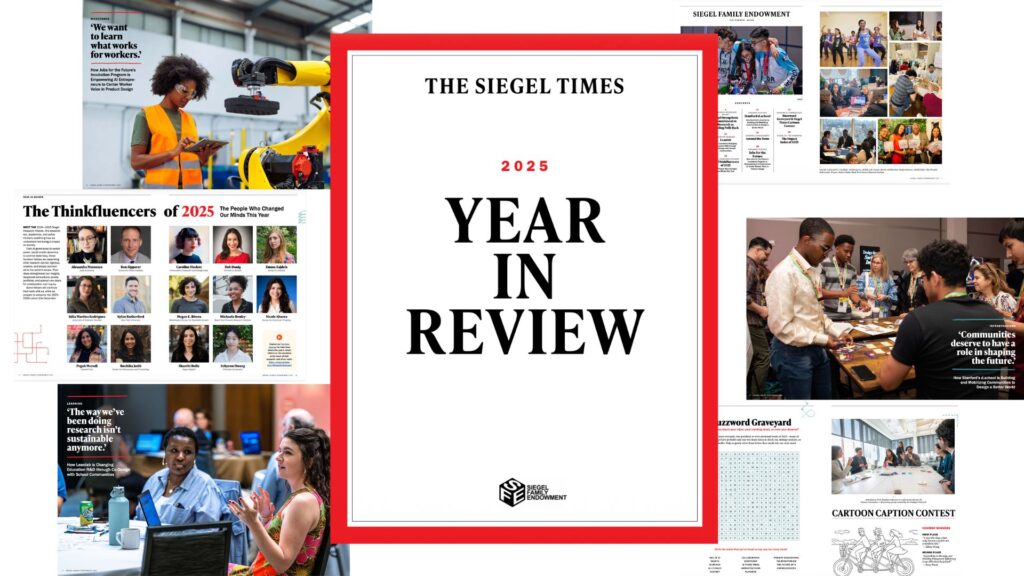
At the close of the year, we’re marking the moment with The Siegel Times, a special, news-magazine–themed edition of our annual Year in Review. Below, in her special report feature, President and Executive Director Katy Knight explores the blueprints, partnerships, and strategies driving 2025’s most under-covered successes.
According to industry data, new AI tools were launched at a rate of more than three per week in 2025. Simultaneously, polls show that trust in institutions fell to levels last seen during the 2008 financial crisis. The volume and velocity of technological change has increased measurably across sectors. Entire conversations—about work, community, learning, and opportunity—are being reframed in real time. Even the language we use to understand technology has shifted, filled with terms that would have been unrecognizable just a year or two ago.
At the same time, a pattern has emerged in communities nationwide: sustained investments in community-driven infrastructure, computational literacy, and equitable technology governance are producing measurable outcomes, even as they receive limited media attention. This investigative report uncovers the organizations building infrastructure for more equitable technological futures—and also examines the patient investments and coordination strategies that are making this quiet work possible.
Under-Reported Developments With Lasting Impact
Several initiatives that launched or expanded this year represent significant developments in how technology serves public needs:
AI applications beyond consumer tools. Despite rhetoric about AI’s potential for medical, scientific, and climate breakthroughs, much development has focused on general consumer applications. In 2025, AI startups captured 52.5% of all venture capital investment globally—$192.7 billion—with the majority directed toward generative AI application companies. These businesses build specialized software using third-party foundation models for consumer or enterprise use; they’re not focused on hoped-for transformative advances in science.
Yet, new platforms launched this year address the gap by targeting specific scientific and community needs. Open Athena closes the gap between academia and the AI frontier by integrating world-class engineers, computing power, and open development practices directly into leading university labs. This year, Open Athena helped researchers at Stanford, MIT, NYU, Princeton, Cornell, and other institutions build and release scientific foundation models in genomics, climate, materials science, and general-purpose AI—tools that would not have been possible within traditional academic constraints. By transforming promising prototypes into open, reusable AI infrastructure, Open Athena is helping true scientific discovery in the age of AI.
Coalitions are shaping fairer, more transparent technology. Americans are much more concerned than excited about the increased use of AI in daily life, with a majority saying they want more control over AI, according to a 2025 Pew Research Study. Collaborative initiatives aim to reverse this pattern.
One major effort is Humanity AI, a broad coalition uniting leaders in philanthropy to invest in a more inclusive, prosperous future in which AI is shaped by and for the people. Communities most affected by technological change can be a part of the development of technology rather than just be on the receiving end of its deployment.
Opportunity AI brings together over 100 professionals from more than 50 philanthropies to accelerate economic mobility through strategic AI applications. The initiative addresses a gap in the impact sector, which has lagged behind for-profit entities in AI adoption due to limited capital.
The Public Interest Technology University Network (PIT-UN) is cultivating the next generation of civic-minded technologists through university collaboration. Since 2019, PIT-UN members, which include over 60 universities, colleges, have created career pathway models for practitioners-in-training while supporting faculty in their efforts to make public interest technology a well-recognized and well-funded academic discipline. These coalitions represent infrastructure: building capacity, knowledge-sharing mechanisms, and coordinated funding models that extend beyond individual projects to create pathways for equitable technology development.
Computational thinking programs demonstrate sustained relevance amid technological shifts. Despite claims that AI is rendering coding and other technical skills obsolete, an estimated 92% of all jobs now require digital proficiency, according to a National Skills Coalition report. Higher-paying positions—particularly in AI development—continue to demand computer science knowledge. Computational thinking is a literacy that develops enduring skills beyond career preparation: creativity, problem-solving, logic, and persistence. These are foundational skills regardless of shifting technological trends.
Programs designed around this principle are achieving significant reach: Scratch, the programming platform built to inspire creative learning for young people, serves over 150 million users across every country, enabling children to build interactive stories, games, and animations. This work—from early computational thinking lessons through high school and college computer science courses—is and will remain one of the most important investments in the innovation age.
Progress made towards more intentional distribution of the benefits of AI. The Center on Rural Innovation (CORI) has implemented a community-centered approach to technology-based economic development in more than 40 communities across 25 states. CORI’s model includes a mix of investments in digital infrastructure, local talent development, and startup support based on a community’s assets and needs, creating what researchers describe as a self-reinforcing cycle. Skilled jobs attract new businesses, generating innovation, which, in turn, creates additional employment and entrepreneurial activity. The economic impact is measurable. Rural counties with high broadband usage experience 213% higher growth in new business establishments and 44% higher GDP growth compared to those with low usage, according to CORI’s 2024 analysis. By prioritizing local entrepreneurship and skill development over recruitment of outside firms and talent, the framework ensures existing community members benefit first from emerging opportunities.
Media Analysis: The Visibility Gap
Clearly there’s a lot to be excited about, but why has it not captured more attention? The visibility gap between news about big consumer AI and news about community-driven technology reflects structural imbalances in media attention and resource allocation. When AI makes headlines, it’s typically a product launch from Big Tech—not tools designed to solve local or social problems.
Consider Code the Dream‘s work: MyFriendBen, a free benefit screener available in 16 languages, helps North Carolinians identify approximately $2,500 in monthly savings through a six-minute eligibility check covering 18+ programs. UpState, another Code the Dream tool, enables civil society stakeholders to track and analyze state legislation, democratizing access to and influence in the policymaking process. These applications address real needs—economic security and civic participation—yet generate minimal media attention. Siegel grantees across all issue areas report that this visibility gap affects their ability to attract diverse funding sources, creating a cycle where impactful work remains under-resourced and under-recognized.
This disparity isn’t accidental: technology companies command massive PR budgets and cultivate relationships with many kinds of influencers, while social impact organizations operate with lean communications teams and compete for coverage on different beats entirely. The result is a public narrative about AI that centers corporate innovation rather than community-driven solutions.
The team at Siegel is funding and elevating this under-covered work, aiming to shift what counts as newsworthy innovation. As 2025 closes, the infrastructure being built today will shape what becomes possible in the next decade. This work, whether or not it generates headlines, represents the kind of patient investment that defines long-term outcomes.
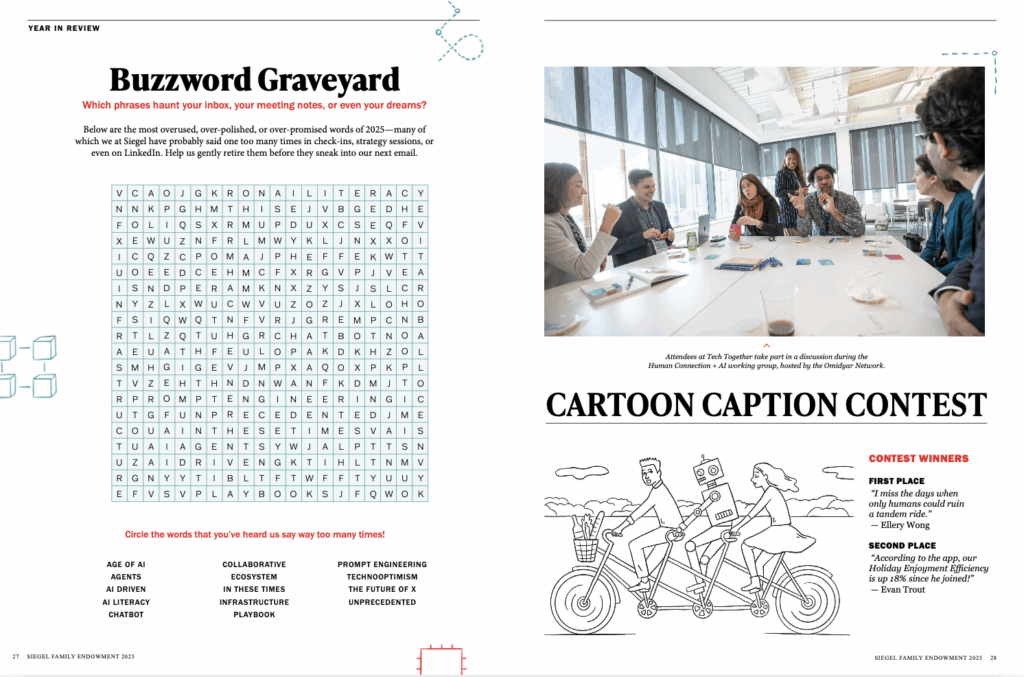
Read more, including our Buzzword Graveyard Wordsearch, and our Cartoon Caption Contest Winners, in the full report.
Join us for our annual “Ask Me Anything” webinar Thursday, February 5th to learn more about our plans for 2026.