How we’re exploring inquiry-driven philanthropy through curiosity, rigor, and shared learning
When we launched Siegel Family Endowment, none of us came from philanthropy.
What we brought instead was a different starting point: a founder with a PhD in science and a career building and leading technology companies, always returning to a central question of how technology reshapes society, and how societies can adapt in response.
From day one, our guiding question has been simple and persistent: how do we navigate the complexity that technology introduces into the systems we care about? And just as importantly, what tools, methods, and practices can help us do that in a way that is iterative, adaptive, and honest about uncertainty?
Over the past decade, we’ve approached grantmaking much like a research process. We start with questions, develop learning agendas and hypotheses in partnership with grantees, and then adapt as we go, based on what we learn together. Not because we believed it was the only or best way to do philanthropy, but because we didn’t assume we had the answers.
Over time, something became clear: this way of working had become more than a set of practices. It had become a coherent approach to inquiry-driven grantmaking.
And increasingly, our grantees and partners reflected that back to us. They told us, “this feels different,” and encouraged us to share more openly how it works. Peers asked, “what does this actually look like in practice? What frameworks sit underneath it, and how it translates into real grantmaking decisions?”
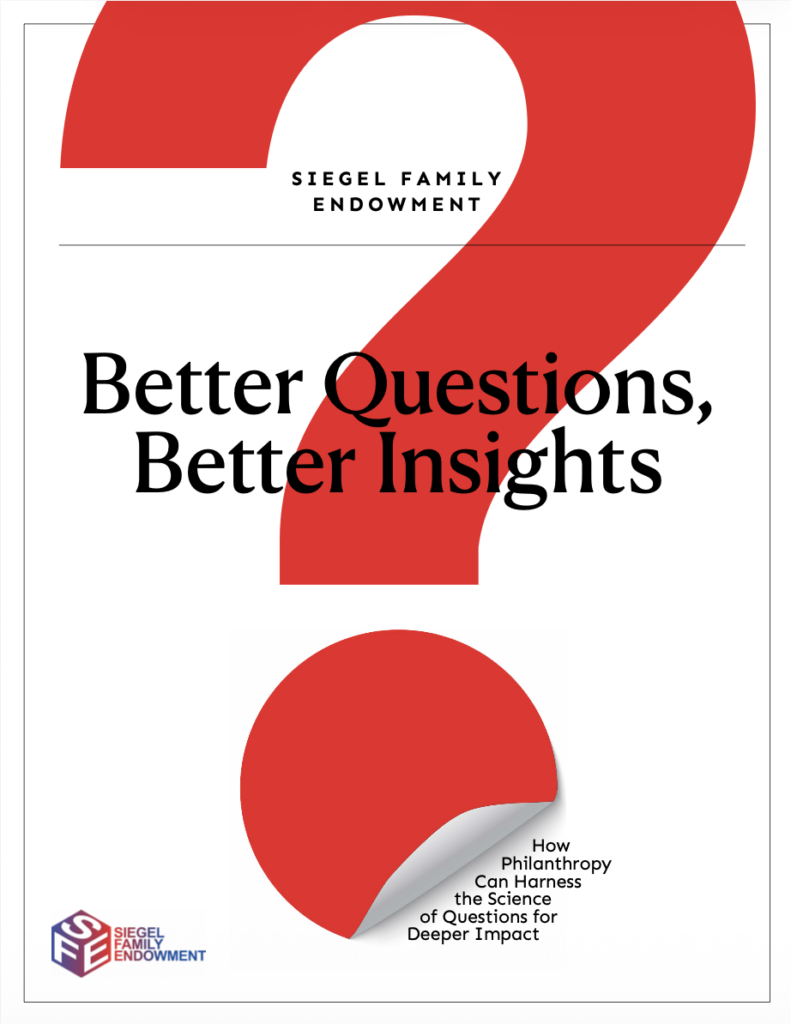
Better Questions, Better Insights is our attempt to do that.
This whitepaper is a codification of a decade of learning. Not as a definitive model, but as one approach that has been useful for us in practice. It includes what we’ve found to work well, where we’ve struggled, and the kinds of tools and structures we’ve used to support an inquiry-driven orientation to philanthropy.
At its core, the paper explores a shift in how funders and partners can work together.
Inquiry-driven grantmaking starts with a shared question—one that neither funder nor grantee can answer alone. From there, both sides are learning, both are adapting, and both are accountable not just to outputs, but to what is being discovered along the way.
We’ve found this approach to be especially powerful in complex, systemic contexts where solutions are not known in advance, where the people closest to the work hold critical insight, and where space for surprise often leads to the most meaningful breakthroughs.
This paper is an invitation to engage with that approach more deeply. It’s a look under the hood at how we’ve been working, and a resource for others exploring similar questions in their own practice.
We hope it’s useful and we’re grateful, as always, for the ongoing learning we share with our grantees and partners.