External Engagement
at Siegel
Our Mission
To connect change instigators—ideas, proof points, opportunities—with change makers in our focus areas.

Our Vision
We design interventions to shift narratives toward a world in which everyone has “choice and voice” in the technology they want.
Longer term, we’re building toward a future where compelling, widely-seen stories about technology feature human-centered, community-driven approaches. We envision public discourse about AI and automation that includes narratives of agency, creativity, and possibility alongside necessary critique—stories that help people imagine and build better technological futures.
Our Guiding Star
The guiding star of External Engagement at Siegel is behavior change—both individual and collective. Everything we do aims to shift how people think, talk about, and act on technology’s impact on society.
Our Two-Pronged Approach

1. Inspire Action Through Stakeholder-Centric Communications
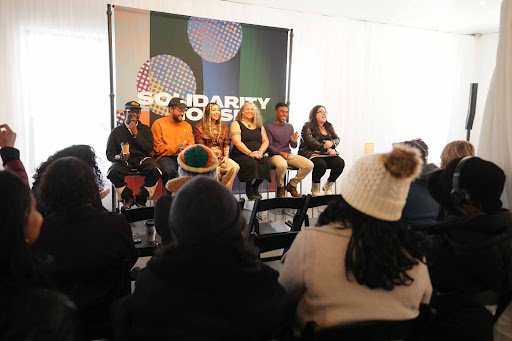
For us, communications is fundamentally about behavior change. We believe in putting evidence and knowledge in the public domain, educating people about issues, and giving them concrete steps to take. When we publish op-eds, case studies, social media content, field guides, or blueprints, they’re all tools in an overarching behavior change toolbox. When we host activations including convenings, side events, and other field-building activities, we design them to catalyze relationships and shift thinking. We aspire to be clear about why we’ve invested effort in any piece of communication or gathering, and what specific behavior we’re trying to influence.
When it comes to large-scale change, we’re surgical in our pursuit. We target the most leveraged audiences—wherever they are and however they communicate—who have the power to make the change we seek. Broad public awareness helps (see Approach #2), but when it comes to produced assets, each must have a clear stakeholder and hypothesis about the pathway to change and the intervention points.
These communications tools are not our end goal; they’re a means. Ultimately, behavior change—individual and collective—is what we’re after.

2. Build Narrative Infrastructure for Long-Term Change
We believe narratives are the grease in the wheels of change. Narrative change work creates the conditions for our grantmaking and research to succeed by shifting how key audiences understand problems and solutions.
Even the best grants and most rigorous research can fail if the broader narrative environment doesn’t support them. When dominant narratives make an idea illegible, marginal, or threatening, it won’t gain traction regardless of its merit. We need stories that help society navigate between dystopia and techno-utopianism—narratives that show both the problems we face and the pathways forward, that educate without paralyzing, that inspire without naive optimism.
Creating a flourishing public interest technology narrative faces several obstacles. Many factors—notably AI – are competing to shape public consciousness. The stories reaching mainstream audiences tend toward extremes: either dystopian warnings or techno-utopian promises from big tech. These un-nuanced narratives leave little room for the complex, human-centered approaches our grantees champion.
Furthermore, today’s major tech platforms are increasingly media platforms. The storytellers of technology are increasingly the owners of technology, warping our perspectives. Engagement is the major product across these platforms. We need to be careful about how we see each other when the stories we consume—and what we learn about the world—are filtered through commodification.
Siegel is not positioned to reach general audiences directly, and that’s not our goal. Instead, we invest in narrative infrastructure – the relationships, platforms, and cultural conditions that determine which stories get told and how they spread. We work with narrative “hubs”—organizations and networks of values-aligned, purpose-driven creators and storytellers who collectively reach substantial audiences. We seek to build relationships with culture makers (including filmmakers, writers, producers, and content creators) who are already telling stories about technology and society. These individuals have the craft to make complex ideas accessible, the platforms to reach diverse audiences, and the power to spark tough conversations about what we want as a society. We learn from them about what stories resonate, what narrative frames are breaking through, and how we can better support storytelling that advances public interest technology.
Our goal isn’t to control the narrative but to flood the market with alternative stories, ensuring that people can find narratives about technology that resonate with their values, reflect their lived experiences, and imagine futures worth building toward.
Our Aspirations
Communications puts out excellent bricks—individual pieces of content that demonstrate what’s possible.
Narrative is the architecture—the underlying structure that gives those bricks meaning, shows how they fit together, and creates something larger than the sum of parts.
Together, stakeholder-centric communications and narrative infrastructure building create the conditions for sustained behavior change. We reach specific high-leverage audiences with targeted interventions while simultaneously shifting the broader cultural conversation that shapes how millions of people understand technology’s role in society.
This integrated approach means our work compounds over time. Strong narratives amplify the impact of individual grants. Clear stakeholder focus makes our communications more strategic. And by building infrastructure rather than just producing content, we create conditions where more voices can participate in shaping how society navigates our technological future.